

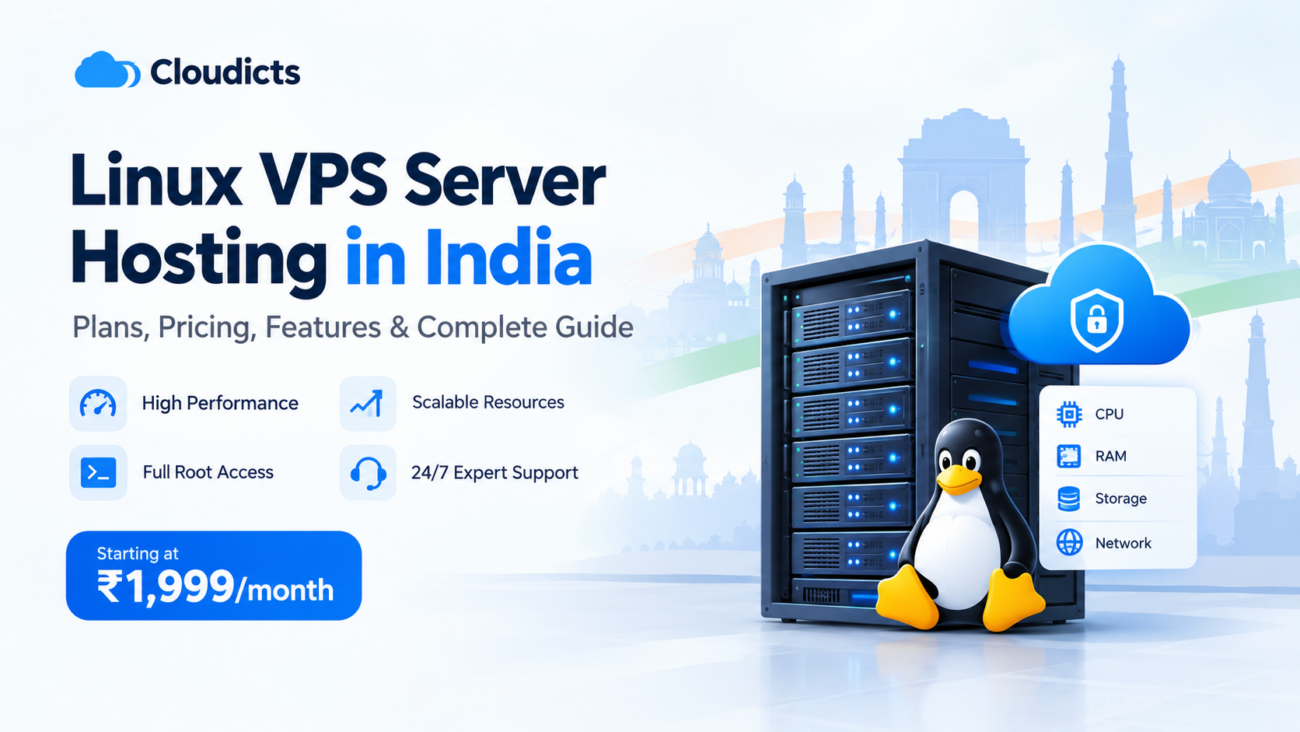
Choosing the right hosting solution is important for any growing website, application, online store, SaaS platform, or business. While shared hosting can work well for smaller websites, growing projects often need more CPU, RAM, storage, flexibility, and server-level control.
This is where Linux VPS Server Hosting in India can be a practical solution.
A Linux VPS provides an isolated virtual server environment with allocated CPU, RAM, and storage resources. It offers greater flexibility and control than traditional shared hosting while providing a more accessible alternative to a physical dedicated server.
For businesses serving customers in India, choosing suitable VPS infrastructure can also be an important consideration for application performance, network connectivity, and hosting architecture.
Cloudicts offers managed Linux VPS hosting in India with plans starting at ₹1,999 per month, along with higher-resource configurations for websites, applications, databases, SaaS projects, and business workloads.
What Is Linux VPS Server Hosting?
Linux VPS Server Hosting is a hosting service that provides a virtual private server running on a Linux-based operating environment.
A physical server can be divided into multiple isolated virtual server environments using virtualization technology. Each VPS receives allocated resources such as:
- CPU or vCPU
- RAM
- Storage
- Network connectivity
- Operating system environment
- Server-level configuration capabilities
Unlike traditional shared hosting, a VPS provides a more isolated environment and greater control over server configuration.
Linux is widely used for hosting websites, web applications, APIs, databases, development environments, content management systems, and other compatible workloads.
With managed Linux VPS hosting the hosting provider can also assist with server administration and infrastructure-related requirements.
Why Choose Linux VPS Server Hosting in India?
For businesses targeting customers in India, hosting infrastructure suitable for the Indian market can be an important part of an overall hosting strategy.
A Linux VPS can provide several advantages compared with basic shared hosting.
Dedicated Virtual Resources
A VPS environment provides allocated CPU, RAM, and storage resources. This can make it suitable for websites and applications that have outgrown basic shared hosting.
Greater Server Control
VPS hosting provides more control over the hosting environment, configurations, applications, and server-level requirements.
This can be particularly useful for developers, agencies, application owners, and businesses that need greater flexibility.
Scalability
As your website or application grows, your resource requirements can also increase. A VPS makes it possible to move toward higher-resource configurations as your workload grows.
Business-Friendly Hosting
Linux VPS hosting can support business websites, APIs, databases, SaaS applications, eCommerce projects, development environments, and other compatible workloads.
Managed Server Support
A managed VPS can reduce the amount of server administration that a business needs to handle independently.
Cloudicts describes its managed Linux VPS service as providing management support for server administration and infrastructure-related requirements.
Cloudicts Managed Linux VPS Hosting Plans in India
Cloudicts currently offers three managed Linux VPS configurations.
| Plan | CPU | RAM | Storage | Network Speed | Price |
|---|---|---|---|---|---|
| LM-VPS 1 | 2 vCPU | 4 GB | 50 GB NVMe | Up to 1 Gbps | ₹1,999/month |
| LM-VPS 2 | 8 vCPU | 16 GB | 200 GB SSD | Up to 1 Gbps | ₹3,999/month |
| LM-VPS 3 | 12 vCPU | 24 GB | 300 GB SSD | Up to 1 Gbps | ₹5,999/month |
These are the plan specifications and prices currently listed on the Cloudicts Managed Linux VPS page.
Linux VPS Server Price in India
The price of a Linux VPS server in India depends on several factors, including CPU, RAM, storage, network connectivity, management services, security, backups, and support.
Cloudicts’ managed Linux VPS plans currently start at ₹1,999 per month.
The entry-level LM-VPS 1 includes:
- 2 vCPU
- 4 GB RAM
- 50 GB NVMe storage
- Up to 1 Gbps network speed
- Managed Linux VPS environment
For workloads requiring more resources, LM-VPS 2 provides 8 vCPU and 16 GB RAM, while LM-VPS 3 provides 12 vCPU and 24 GB RAM.
Cloudicts also currently displays a 10% discount using the code FLAT10. Promotional pricing, eligibility, and applicable terms should be confirmed before purchase.
Which Linux VPS Hosting Plan Should You Choose?
The best Linux VPS plan depends on your website, application, traffic, database size, and resource requirements.
LM-VPS 1 – 2 vCPU, 4 GB RAM
The LM-VPS 1 plan provides 2 vCPU, 4 GB RAM, and 50 GB NVMe storage.
It can be considered for:
- Small business websites
- Growing WordPress websites
- Development environments
- Small web applications
- Low-to-moderate traffic projects
- Websites moving beyond shared hosting
Price: ₹1,999/month
LM-VPS 2 – 8 vCPU, 16 GB RAM
LM-VPS 2 provides 8 vCPU, 16 GB RAM, and 200 GB SSD storage.
It can be suitable for:
- Growing business websites
- eCommerce applications
- Web applications
- APIs
- Larger databases
- Multiple websites or applications
- Development and production workloads
Price: ₹3,999/month
LM-VPS 3 – 12 vCPU, 24 GB RAM
LM-VPS 3 provides 12 vCPU, 24 GB RAM, and 300 GB SSD storage.
It can be considered for:
- Larger web applications
- Resource-intensive workloads
- SaaS applications
- Database-intensive applications
- Multiple services
- Projects requiring additional CPU and RAM
Price: ₹5,999/month
The appropriate plan should be selected according to actual resource utilization rather than simply choosing the most powerful configuration.
Managed vs Unmanaged Linux VPS Hosting
Before purchasing a Linux VPS, it is important to understand the difference between managed and unmanaged hosting.
Managed Linux VPS
With managed VPS hosting, the hosting provider assists with server administration and infrastructure-related requirements.
This can be useful for:
- Business owners
- Agencies
- eCommerce teams
- Developers who want to reduce infrastructure administration
- Businesses without a dedicated system administrator
The main advantage is convenience. You can use VPS-level resources without necessarily having to handle every server administration task yourself.
Unmanaged Linux VPS
With unmanaged VPS hosting, the customer takes greater responsibility for server administration.
This may include:
- Server configuration
- Operating system updates
- Firewall configuration
- Security management
- Application deployment
- Troubleshooting
- Monitoring
- Backup configuration
Unmanaged VPS hosting can be suitable for experienced technical users who want to manage the server themselves.
For businesses that want infrastructure assistance, managed Linux VPS hosting may be a more convenient option.
Key Features of Cloudicts Managed Linux VPS
Cloudicts highlights several features as part of its managed Linux VPS offering.
Managed Server Environment
Cloudicts provides assistance with server administration and infrastructure-related requirements.
Dedicated VPS Resources
The virtual server operates with allocated CPU, RAM, and storage resources.
Linux-Based Infrastructure
The Linux-based environment can support many modern websites, applications, APIs, databases, and development workloads.
Scalable Hosting
Businesses can move toward higher-resource configurations as their hosting requirements increase.
More Control Than Shared Hosting
VPS hosting provides greater control than traditional shared hosting and can support applications that require VPS-level resources.
Security-Focused Management
Cloudicts highlights server security configuration and maintenance practices as part of its managed VPS approach.
What Can You Host on a Linux VPS Server?
One of the biggest advantages of Linux VPS hosting is flexibility.
Depending on your resources and application requirements, a Linux VPS can be used for many different workloads.
Business Websites
Growing business websites can use VPS hosting when shared hosting becomes restrictive or additional server control is required.
eCommerce Websites
Online stores can require additional CPU, RAM, database resources, and configuration flexibility as traffic and product catalogs grow.
A Linux VPS can provide a more controlled environment for compatible eCommerce applications.
SaaS Applications
SaaS businesses can use Linux VPS infrastructure for application servers, APIs, dashboards, backend services, and databases, depending on the application’s architecture and resource requirements.
APIs and Web Applications
Developers can deploy APIs, backend applications, dashboards, and other web services on a Linux VPS.
Development and Staging Environments
A VPS can also be used for development, testing, staging, and production environments.
Databases
Applications requiring configurable database environments can use a VPS where the required database software and server resources can be configured according to the workload.
Linux VPS for Developers
Developers often require more flexibility than traditional shared hosting can provide.
A Linux VPS can provide an environment where developers can:
- Deploy applications
- Configure server software
- Test applications
- Manage dependencies
- Create staging environments
- Run APIs
- Configure databases
- Manage development workloads
Cloudicts lists several operating systems and software environments within its Linux VPS ecosystem, including AlmaLinux, CentOS, OpenBSD, Arch Linux, Ubuntu, CyberPanel, Docker, Webmin, Drupal, Magento, PrestaShop, CWP, and WordPress. Availability may vary depending on the plan and deployment configuration.
Linux VPS for eCommerce Businesses
An eCommerce website needs hosting infrastructure that can support its application, database, traffic, and business requirements.
A Linux VPS can be considered when an online store requires:
- Additional CPU resources
- More RAM
- Better application control
- Dedicated virtual resources
- Database configuration
- Scalable hosting
- Server-level flexibility
As an eCommerce business grows, hosting should be reviewed according to traffic, database requirements, application architecture, and resource utilization.
Linux VPS for SaaS Applications
SaaS applications can have more complex infrastructure requirements than conventional websites.
A SaaS platform may include:
- Frontend applications
- Backend services
- APIs
- Databases
- Background jobs
- Authentication
- Monitoring
- Third-party integrations
A Linux VPS can provide an isolated environment for compatible SaaS workloads.
For larger SaaS platforms, businesses may also need to consider containers, load balancing, managed databases, cloud infrastructure, and other architectural solutions.
Security Best Practices for a Linux VPS
A VPS should not be considered secure simply because it is a VPS.
Security requires ongoing configuration, maintenance, and monitoring.
Keep Your Operating System Updated
Regular operating-system updates help maintain a supported and secure server environment.
Use Strong Authentication
Use strong credentials and appropriate authentication methods for server access.
Configure a Firewall
A firewall can help control which services and ports are accessible from the internet.
Secure Your Applications
Keep CMS platforms, plugins, frameworks, libraries, databases, and other application components updated according to your requirements.
Maintain Backups
Important websites and applications should have an appropriate backup and recovery strategy.
Monitor Server Resources
Monitoring CPU, RAM, storage, network usage, and application performance can help identify potential problems.
Cloudicts recommends considering access controls, operating-system updates, firewall configuration, strong authentication, application security, and regular backups as part of a secure Linux VPS approach.
Linux VPS Hosting vs Shared Hosting
The primary difference between shared hosting and VPS hosting is the level of resources, isolation, and control available.
| Feature | Shared Hosting | Linux VPS Hosting |
|---|---|---|
| Resource allocation | Shared environment | Allocated VPS resources |
| Server control | Limited | Greater control |
| Scalability | More limited | Easier to scale |
| Configuration flexibility | Limited | Higher |
| Suitable for | Smaller websites | Growing websites & applications |
| Administration | Generally simpler | More technical |
| Application flexibility | More limited | Greater flexibility |
Shared hosting can remain a good option for simple websites and smaller projects.
A Linux VPS becomes more attractive when your project needs additional resources, configuration flexibility, or server-level control.
Linux VPS Hosting vs Dedicated Server
A dedicated server provides an entire physical server to one customer, while a VPS provides an isolated virtual server environment.
Choose Linux VPS Hosting When:
- You need allocated virtual resources
- You want more control than shared hosting
- You want to scale resources
- You don’t require an entire physical server
- You want a balance between performance and cost
Choose Dedicated Server Hosting When:
- You require an entire physical server
- Your workload consistently requires significant resources
- You need hardware-level customization
- Your application requires dedicated physical hardware
For many growing businesses, VPS hosting can provide a practical middle ground between shared hosting and dedicated servers.
How to Choose the Best Linux VPS Server Hosting in India
When comparing Linux VPS Server Hosting in India, don’t select a provider based only on the lowest price.
Consider the following factors.
1. CPU and RAM
Check whether the VPS provides enough CPU and RAM for your website or application.
2. Storage
Look at both storage capacity and storage technology.
Cloudicts’ current plans include either NVMe or SSD storage depending on the plan.
3. Network Connectivity
Check advertised network speeds, bandwidth policies, and connectivity relevant to your users.
4. Server Location
If most of your customers are in India, consider infrastructure locations and network routes that are appropriate for your target audience.
5. Managed Support
If you do not have server administration expertise, managed support can be an important consideration.
6. Backup Options
Understand whether backups are available, how frequently they are performed, and how restoration works.
7. Security
Review server security practices, access controls, firewall configuration, monitoring, and maintenance.
8. Upgrade Options
Your hosting provider should offer a practical path to higher-resource configurations as your business grows.
9. Operating System Compatibility
Check whether the provider supports the Linux distribution and software stack required by your application.
10. Technical Support
For business-critical applications, reliable technical support can be an important part of the hosting decision.
Is Linux VPS Hosting Good for a Small Business?
Yes, a Linux VPS can be a good choice for a small business when its website or application has outgrown shared hosting or requires additional server control.
However, every small business does not necessarily need a VPS.
If your website has low traffic and simple hosting requirements, shared hosting may be sufficient.
A Linux VPS becomes more relevant when you need:
- More resources
- Greater control
- Custom software
- Better isolation
- Application-level configuration
- Scalability
Is Managed Linux VPS Hosting Good for Beginners?
Managed Linux VPS hosting can be suitable for beginners who want VPS-level resources without handling every server administration task independently.
However, some Linux and application-level knowledge may still be required depending on the workload.
Cloudicts specifically positions its managed Linux VPS for customers who want VPS performance without handling every server administration task themselves.
Frequently Asked Questions About Linux VPS Server Hosting in India
What is Linux VPS Server Hosting in India?
Linux VPS Server Hosting in India is a virtual private server hosting service using a Linux-based operating environment for websites, applications, databases, and other compatible workloads. A VPS provides an isolated virtual environment with allocated resources such as CPU, RAM, and storage.
How much does Linux VPS hosting cost in India?
The price depends on CPU, RAM, storage, management, network connectivity, and other features. Cloudicts currently lists managed Linux VPS plans starting at ₹1,999 per month, followed by ₹3,999/month and ₹5,999/month configurations.
Which Linux VPS plan is best for a business website?
For a smaller business website, the LM-VPS 1 configuration with 2 vCPU and 4 GB RAM can be considered as a starting point. Larger websites should evaluate their actual CPU, RAM, storage, database, and traffic requirements before selecting a plan.
Is Linux VPS better than shared hosting?
Linux VPS hosting provides greater resource allocation and server control than traditional shared hosting. However, shared hosting may still be appropriate for smaller websites with basic requirements.
Is managed VPS better than unmanaged VPS?
It depends on your requirements. Managed VPS hosting is generally more convenient for businesses that want assistance with server administration. Unmanaged VPS hosting can be appropriate for technical users who prefer to manage the server themselves.
Can I host WordPress on a Linux VPS?
Yes. WordPress can be hosted on a Linux VPS when the server has the required software and resources. Cloudicts lists WordPress among the software environments available within its Linux VPS ecosystem.
Can I host an eCommerce website on a Linux VPS?
Yes. A compatible eCommerce website can be hosted on a Linux VPS. The appropriate VPS configuration depends on traffic, database requirements, application architecture, and resource usage.
Can a Linux VPS be upgraded?
VPS resources can generally be upgraded when higher-resource configurations are available. Cloudicts currently provides three managed Linux VPS configurations with increasing CPU, RAM, and storage resources.
Is Linux VPS hosting secure?
A VPS can be configured securely, but security requires ongoing maintenance. Strong authentication, operating-system updates, firewall configuration, application security, monitoring, and appropriate backups are important security practices.
What is the difference between VPS and dedicated server hosting?
A VPS provides an isolated virtual server environment, while a dedicated server provides an entire physical server to one customer. VPS hosting can offer a balance between resources, control, flexibility, and cost.
Final Verdict: Is Linux VPS Server Hosting in India Right for You?
Linux VPS Server Hosting in India can be a strong option for businesses, developers, agencies, eCommerce stores, SaaS companies, and application owners who need more resources and control than traditional shared hosting provides.
The best VPS is not necessarily the cheapest or most powerful option. Instead, choose a configuration based on your actual CPU, RAM, storage, network, application, security, and scalability requirements.
Cloudicts currently offers managed Linux VPS plans starting at ₹1,999/month, with additional configurations priced at ₹3,999/month and ₹5,999/month.
If your website or application is growing and shared hosting is becoming restrictive, a managed Linux VPS can provide the additional resources, flexibility, and server-level control needed for your next stage of growth.
Linux VPS Hosting Buying Checklist
Before purchasing a Linux VPS, check:
- ✓ CPU/vCPU allocation
- ✓ RAM
- ✓ SSD or NVMe storage
- ✓ Network speed and bandwidth
- ✓ Server location
- ✓ Managed or unmanaged support
- ✓ Backup options
- ✓ Security features
- ✓ Operating system compatibility
- ✓ Upgrade options
- ✓ Technical support
- ✓ Monthly and renewal pricing
Cloudicts Managed Linux VPS Hosting starts at ₹1,999/month and is designed for customers who want VPS performance with management support.
